If you searched "managed IT services near me," the short answer is this: a managed service provider runs your computers, network, email, and security for a flat monthly fee. You stop calling a technician every time something breaks, and you stop guessing what the bill will be.
This page collects the numbers you actually need before making that decision. What services count as managed IT. What it costs in 2026. What downtime and breaches really cost small businesses. What the Wisconsin numbers say. And the questions to ask a provider before you sign. The sources are listed at the bottom so you can check the figures yourself.
What managed IT actually includes
A managed provider takes ongoing responsibility for the technology your office depends on. A normal contract covers:
- Help desk support for your employees, by phone or remote session
- Monitoring of servers, workstations, and network equipment
- Patching for operating systems and business software
- Backups that are monitored and actually tested
- Email and Microsoft 365 administration, including licensing and security settings
- Firewall, Wi-Fi, and network upkeep
- Endpoint protection and security monitoring
- Vendor coordination: your ISP, phone provider, and software vendors
- A monthly or quarterly review of what is working and what needs attention
Industry research from Datto shows which of these businesses use most: remote monitoring leads at 94% of MSPs, followed by outsourced help desk at 91%, backup and disaster recovery at 89%, email management at 84%, and security services at 81%.
The old model is different in one important way. Break-fix means a technician shows up after the damage and bills by the hour. Managed IT means the provider benefits when problems never happen. A flat fee aligns their incentive with yours.
What managed IT costs in 2026
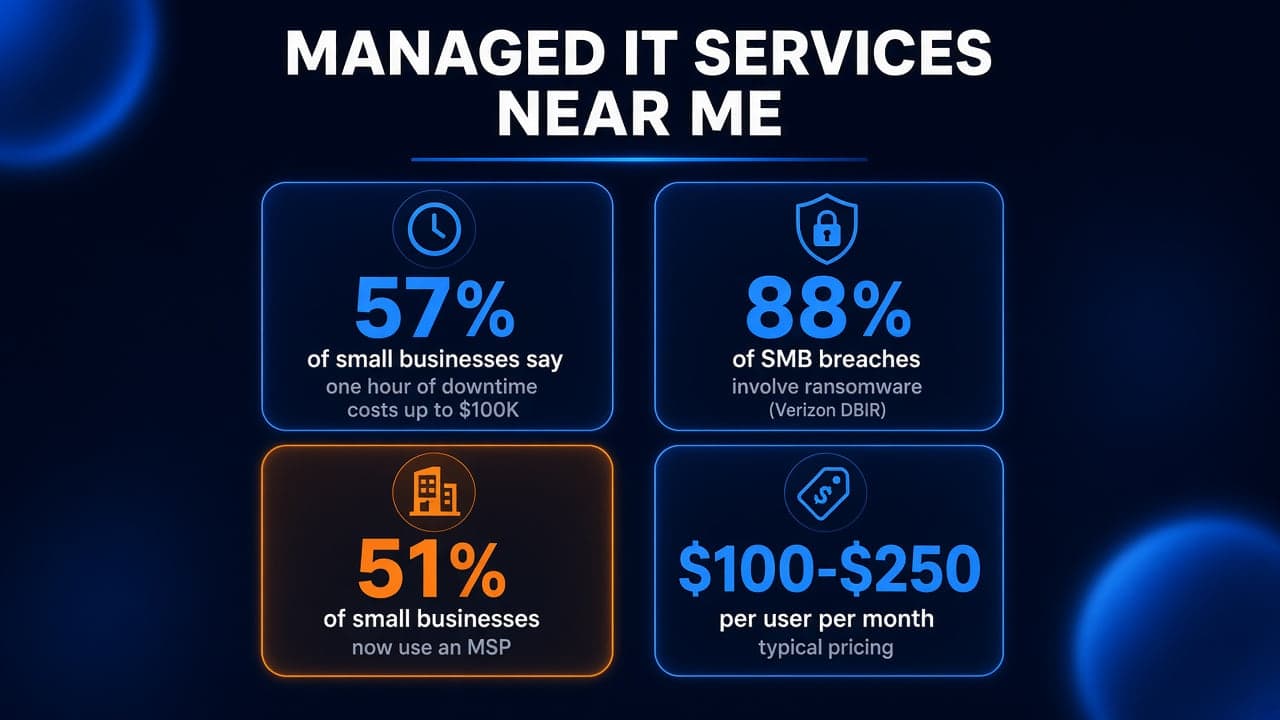
Pricing guides for 2025 and 2026 put full managed IT in the United States at roughly $100 to $250 per user per month. Security-forward packages run closer to $150 to $250. If your business carries compliance requirements, such as healthcare, legal, or finance, expect $250 to $300 per user per month.
| Plan tier | Typical cost | Usually includes |
|---|---|---|
| Entry | $100-$150/user/mo | Business-hours help desk, monitoring, patching, basic antivirus |
| Mid-range | $150-$250/user/mo | 24/7 monitoring, endpoint detection and response (EDR), Microsoft 365 management, quarterly reviews |
| Compliance-heavy | $250-$300/user/mo | Everything above, plus documented controls and audit support |
Two costs get missed in most comparisons. First, the onboarding fee, usually one to three times the monthly rate. First weeks involve documenting your setup, fixing what is broken, and deploying their tools. Second, co-managed IT, where you keep some internal staff and outsource the rest, typically runs 30% to 50% cheaper per user.
Put it in real numbers: a 20-person office should expect $2,000 to $6,000 a month depending on tier, and a 50-person office $5,000 to $15,000. The truthful answer to "what does it cost" is that it depends on your environment, which is why the vetting questions below matter more than the sticker price.
We publish specific Milwaukee-area pricing with real client examples in a separate post if you want to see how that range lands locally.
The cost of doing nothing
The numbers behind "we will call someone when it breaks" are uncomfortable.
ITIC has run its hourly cost of downtime survey for over a decade. Among small businesses with 20 to 100 employees, 57% say one hour of downtime costs them up to $100,000. Even a micro-business under 25 employees faces roughly $100,000 per hour by ITIC's estimate, about $1,670 per minute. Only about one in five organizations can actually calculate their own number. Most owners are guessing at the exposure they carry.
The breach numbers are worse. Verizon's 2025 Data Breach Investigations Report analyzed 22,052 incidents and 12,195 confirmed breaches. Ransomware appeared in 88% of breaches affecting small and medium businesses, versus 39% at larger organizations. IBM's 2025 Cost of a Data Breach report puts the average breach cost for businesses with fewer than 500 employees at $3.31 million. Few small companies absorb that and keep operating.
And one more: CISA notes the FBI reported over $2.7 billion in losses from business email compromise alone in 2024. That is a single attack type, one where a well-written email tricks a bookkeeper into moving money.
What the data says about small business risk
The 2025 Verizon DBIR effectively ends the "we are too small to be a target" argument. For small businesses, three attack patterns caused 96% of breaches: system intrusion, social engineering, and basic web application attacks. Stolen credentials showed up in 34% of those breaches, and roughly 60% still involve a human element somewhere.
Two 2026 trends are worth your attention. Exploitation of vulnerabilities as an entry point grew 34% in one year, and attacks on edge devices and VPNs grew from 3% to 22% of exploited vulnerability cases. Attackers are not kicking in your front door. They are finding the unpatched firewall, the forgotten VPN appliance, or the stale account on the network edge.
Providers who describe security as "a firewall and antivirus" are working from an old playbook. The current baseline is enforced multi-factor authentication (MFA), endpoint detection and response, immutable backups with tested restores, a written incident response plan, and security awareness training. CISA publishes free guidance for small businesses covering all of these.
Wisconsin by the numbers
The national statistics play out locally. Wisconsin has roughly 516,000 small businesses, according to the SBA Office of Advocacy's state profile, and they employ about 48% of the state's workforce, above the national share. Most of those businesses are law firms, accounting offices, manufacturers, and professional services, not tech companies.
The FBI's 2025 Internet Crime Report shows the state is not exempt. Nationwide, the IC3 received 1,008,597 complaints with reported losses exceeding $20.8 billion, up 26% from the prior year. Wisconsin ranked 19th nationally with nearly 17,000 complaints and 26th in reported losses at over $194 million, according to the FBI's Milwaukee field office summary.
Why businesses switch to managed IT
This is no longer a niche model. The managed services market is roughly $380 billion globally in 2026, growing around 11% a year per MarketsandMarkets. CloudSecureTech's analysis puts it near $401 billion for 2025 and forecasts about $847 billion by 2033. Analysts disagree on the exact sizing, so treat the range as the signal.
Adoption has crossed into the mainstream. CloudSecureTech found 51% of small and midsize businesses now use an MSP, rising to 62% of midsize firms, with 61% outsourcing at least some IT. ConnectWise found 48% of companies with 50 to 499 employees use an MSP as their primary IT support model. CompTIA research, cited across MSP industry analyses, found roughly 59% of small businesses that engaged an MSP cut IT costs within the first year.
The IDC numbers explain the timing. Global SMB IT spending reached about $1.1 trillion in 2025 and is projected to grow another 7% in 2026. Cloud is now the single largest budget category at 31 cents of every IT dollar. Technology spending has become a monthly operating cost rather than an occasional capital purchase, and that favors subscription IT.
How to vet a provider near you
Ask every provider on your shortlist the same questions and write down the answers side by side. Strong providers answer with specifics and documentation. Weak ones answer with adjectives.
- How enforced is MFA? They should show you where MFA is switched on across email, remote access, and admin accounts, not just recommend it.
- When was the last restore test? Insurers and CISA treat tested backups as the standard. A provider that cannot name the last date a client's backup was restored is running untested backups.
- What security is included? EDR, email filtering, and security training should be in the base plan, not upsells.
- Who answers at 2 a.m. on Saturday? Ransomware does not wait for business hours. Ask for the real after-hours response path, in writing.
- What is the incident response plan? A two-page document with named roles beats a 50-page binder nobody has read.
- What happens when we leave? Long lock-in terms, vague exit clauses, or trouble getting your data back are red flags in 2026.
For a deeper version of this, our Milwaukee MSP buying guide walks through support models, in-house cost math, and how to pressure-test security claims.
Quick answers
What is the difference between managed IT and break-fix?
Managed IT is a flat monthly subscription for monitoring, support, and maintenance. Break-fix bills per incident after something breaks. One provider is motivated to prevent problems; the other is paid when problems exist.
Is managed IT worth it for a small business?
For most offices with 20 or more employees, the comparison is a predictable monthly bill against hourly downtime that ITIC estimates at up to $100,000 for this size range. CompTIA research found most small businesses that switched cut IT costs in the first year.
What does "managed IT services near me" actually mean?
A local provider who runs your technology for a flat fee. "Near me" matters for on-site visits, response times, and knowing the local business environment. The vetting list above is how you narrow the options.
How much does managed IT cost in Wisconsin?
The national bands apply: roughly $100 to $250 per user per month for full managed IT, higher for compliance-heavy environments and lower for co-managed arrangements. Your quote depends on headcount, security needs, and how much cleanup the onboarding requires.
Does my business need a provider or just better security?
Start with the basics CISA recommends: MFA, patching, backups, and phishing training. If those are not handled consistently today, a provider exists to make them someone's daily job instead of an occasional thought.
The next step
Do ten minutes of math before you call anyone. Write down what one hour of downtime costs your office. Find out when your backups were last tested. Check whether MFA is enforced on every account. Ask yourself what happens after hours when something breaks. Those four answers tell you whether a monthly subscription is an expense or the cheapest insurance you will buy this year.
How Manage IT can help
Manage IT helps Milwaukee area businesses put practical technology in place without making daily work harder than it needs to be. That can mean a full managed IT plan, a security review, tested backups, or just a straight answer about what your office actually needs.
If you want a straight answer about managed IT pricing and what your environment actually needs, contact Manage IT or call (262) 912-6404. We will show you the same numbers we use in our own reports, including what we would fix before we would let you sign.
Sources
- FBI IC3 2025 Annual Report: ic3.gov/AnnualReport/Reports/2025_IC3Report.pdf
- FBI Milwaukee field office summary of the 2025 IC3 report (Wisconsin complaint and loss figures)
- Verizon 2025 Data Breach Investigations Report: verizon.com/business/resources/reports/2025-dbir-data-breach-investigations-report.pdf
- ITIC Hourly Cost of Downtime Survey: itic-corp.com/itic-2024-hourly-cost-of-downtime-part-2/
- IBM Cost of a Data Breach Report 2025 (SMB figures as reported in industry analyses)
- CISA, Secure Your Business: cisa.gov/audiences/small-and-medium-businesses/secure-your-business
- SBA Office of Advocacy, Wisconsin 2025 State Profile
- MarketsandMarkets managed services market sizing, via medhacloud.com/blog/managed-services-market-statistics-2026
- CloudSecureTech MSP Statistics 2026: cloudsecuretech.com/insights/msp-statistics
- Datto Global State of the MSP (service adoption rates)
- ConnectWise and CompTIA research as cited in the sources above
- ITreviews.co MSP Pricing Guide 2026 and MSPCompanies.us pricing roundup (pricing bands)

Powerful IT Systems · Sussex, WI
Master's degree in Computer Science with 15+ years of hands-on IT experience serving Milwaukee-area businesses.